
Microsoft Sustainability Manager supports the implementation of CSRD and ESRS requirements by simplifying sustainability data reporting and management. Built on the Microsoft Power Platform, it can be quickly customized without coding.
The solution standardizes data analysis and automates information flows, helping organizations more effectively track, report, and reduce emissions.
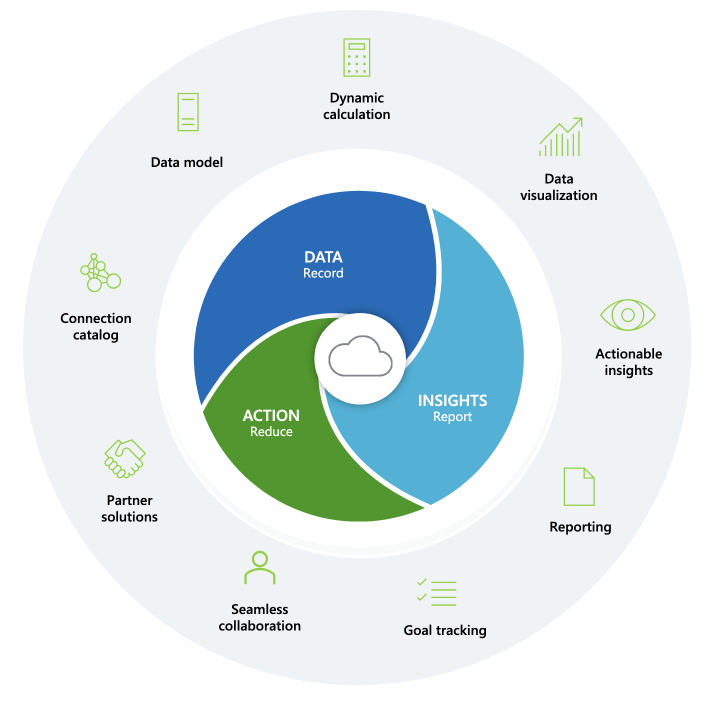



Microsoft Sustainability Manager is a Microsoft Cloud for Sustainability solution, built on the Power Platform, that centralises environmental data – emissions, energy, water, and waste – into one system instead of spreadsheets scattered across departments. It automates the flow of that data into calculations, dashboards, goals, and external ESG reports, and because it’s low-code, most of the customisation needed to fit a specific organisation’s structure or reporting requirements can be done without a development team. In practice, it’s the layer that sits between raw operational data and the sustainability reports a company actually has to produce.
Yes – external reporting in the platform includes a dedicated CSRD template along with workflows for both quantitative and qualitative disclosures, covering report preparation, internal approvals, and audit trails. It’s worth being precise here: the tool structures and supports the reporting process, but it doesn’t guarantee compliance on its own – getting the underlying data right, and interpreting what CSRD/ESRS actually requires for your organisation, still sits with the business.
Beyond CSRD, external reporting also includes templates for GRI, IFRS S1 and S2, SASB, ASRS, and BRSR, so the same platform can serve both mandatory EU reporting and voluntary frameworks a company chooses to report against. For organisations operating across multiple markets, this means one data model can feed several different disclosure formats instead of maintaining separate processes for each standard.
It connects to systems like Dynamics 365 or SAP through Power Query, prebuilt connectors, APIs, or custom integration work, depending on what the source system supports. The exact setup – and how much configuration is needed – depends on the ERP version and how the underlying data is structured, so this is usually one of the first things worth scoping before implementation.
External reporting includes task management and content approval workflows built specifically for ESG disclosures, so review and verification happen inside the same system that holds the data – rather than routing draft reports through email for sign-off, which is where a lot of audit trail tends to get lost.