Agentic AI CRM is a real shift from using CRM as just a database to having a system that actively supports your business. It understands context, helps make decisions, and can take action using AI agents that work alongside your team.
Let’s break down what agentic AI CRM really means, why it matters now, and how organizations are already putting it to work.
What is Agentic AI CRM?
Agentic AI CRM is a new generation of CRM systems powered by AI agents – autonomous software entity that can reason, plan, and act to achieve business goals.
Unlike traditional CRM automation or basic generative AI features, an AI CRM agent doesn’t just respond to prompts. It:
- Understands intent and context
- Decides what needs to happen next
- Handles multi-step actions across systems
- Learns from outcomes over time
In practical terms, a CRM with AI agents can:
- Qualify and prioritize leads without manual rules
- Draft and send follow-ups based on real customer signals
- Update pipelines automatically
- Proactively resolve service issues
- Coordinate actions across sales, marketing, and service
Why traditional CRM systems are no longer enough
Traditional CRM platforms were designed for a world where: customer interactions were fewer and slower, data entry was manual but manageable, sales cycles were linear and predictable, channels were limited and mostly human-led.
Disparate systems and data silos
Customer data lives everywhere: email, chat, calls, meetings, commerce platforms. Traditional CRMs struggle to unify this data in real time, leaving teams with fragmented views and outdated insights.
Manual work and low adoption
Sales reps logging activities. Service agents copying notes. Marketers stitching journeys together by hand. The result? Low adoption and inconsistent data.
Limited intelligence and innovation
Rule-based workflows break the moment reality changes. Static automation can’t adapt to nuance, timing, or customer intent.
High total cost of ownership
More tools, more integrations, more maintenance – often without proportional business value.
This is exactly where agentic AI CRM changes the game.
How Agentic AI CRM solves these challenges
Unified customer data and orchestration
Agentic systems operate on live, unified data across channels and departments. AI agents don’t just read data – they act on it.
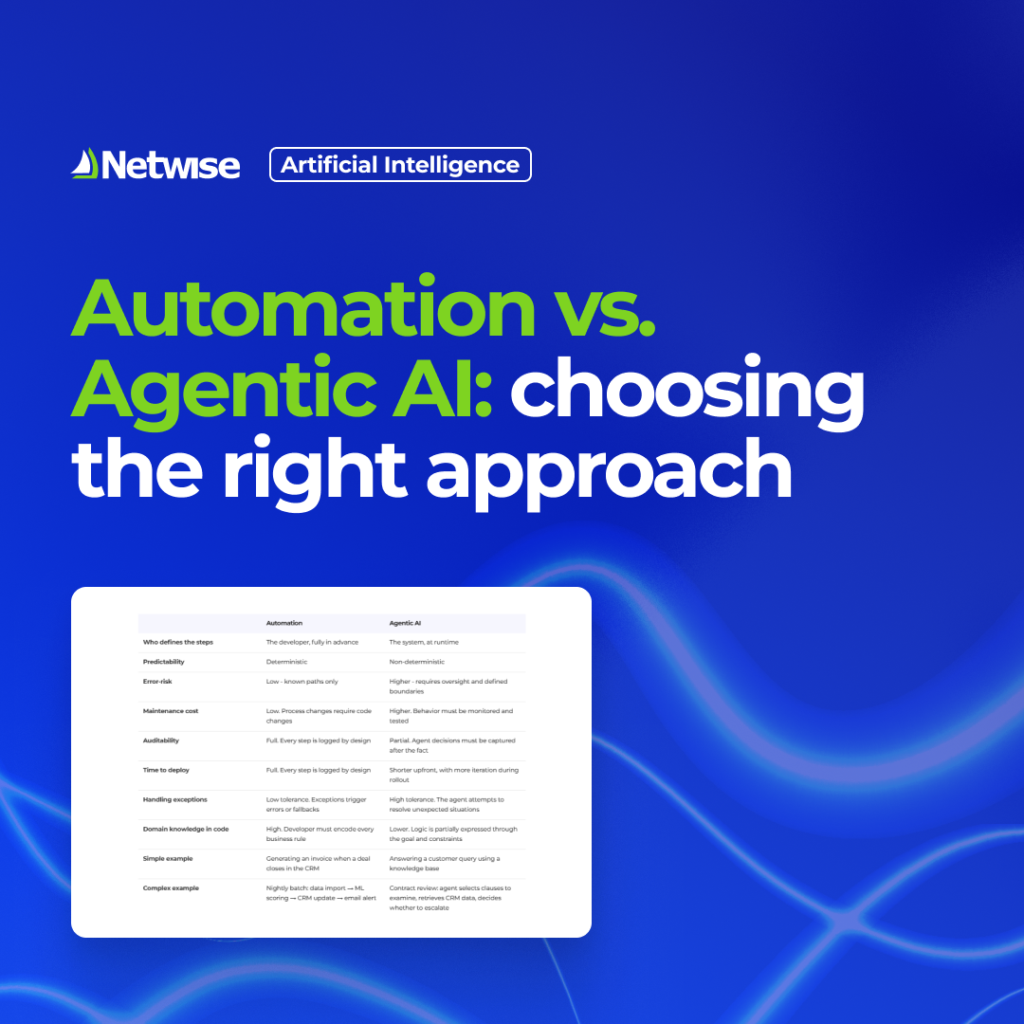
Autonomous AI agents vs. rule-based automation
Instead of “if-this-then-that” logic, AI agents for CRM reason dynamically:- What is the goal?
- What information is missing?
- What action will move this forward now?
Intelligence built-in, not added on
In a true agentic AI CRM, AI is embedded into core workflows – not added as a chatbot on top of outdated processes.
Lower operational cost through consolidation
Fewer manual tasks, fewer disconnected tools, and smarter execution reduce both cost and friction.How Agentic AI CRM works in practice
Key capabilities of an Agentic AI CRM
AI agents that plan, decide, and act
An AI agent in CRM can handle complex, multi-step processes – like nurturing a lead from first interaction to qualified opportunity – without constant human input.
Natural language interaction
Teams can interact with CRM using natural language:
“Show me deals at risk this quarter and propose next actions.”
The system understands, executes, and responds.
Contextual memory and continuous learning
Agentic AI systems retain context across interactions and improve over time – learning which actions actually drive outcomes.
Human-in-the-loop control
Autonomy doesn’t mean loss of control. Humans define goals, guardrails, and approvals – AI agents handle execution.Real-world examples of Agentic AI CRM in action
Sales
AI agents qualify leads based on engagements signals, conduct research on prospects to better prepare for meetings, track opportunities and flag potential deal risks, update pipelines, and trigger follow-ups – freeing sales teams to focus on relationships and closing.
Here are the key, built-in agents available for Dynamics 365 Sales: Sales Qualification Agent, Sales Close Agent – Research and Sales Close Agent – Engage.
Customer service
AI agents proactively detect issues, resolve cases, and escalate only when human judgment is truly needed. The examples of such agents in Dynamics 365 Customer Service are the Customer Intent Agent, Customer Knowledge Management Agent, Quality Evaluation Agent, and Case Management Agent.
This is CRM moving from reactive support to proactive engagement.
The future of CRM: from systems of record to systems of action
Agentic AI marks a clear transition:
- From automation -> autonomy
- From reactive workflows -> proactive engagement
- From CRM users -> AI-augmented teams
Organizational readiness matters
Technology alone isn’t enough.
To succeed with agentic AI CRM, company needs:
- High-quality, governed data
- Clear ownership between humans and AI
- Upskilling teams to work with AI agents, not around them
- Change management focused on trust and transparency
How to start your Agentic AI CRM journey
Start small. Focus on one function – sales, service, or marketing – and identify where autonomous agents can remove friction and create immediate value.
Agentic AI CRM improves how work gets done and how people experience it – on both the customer and team side.